
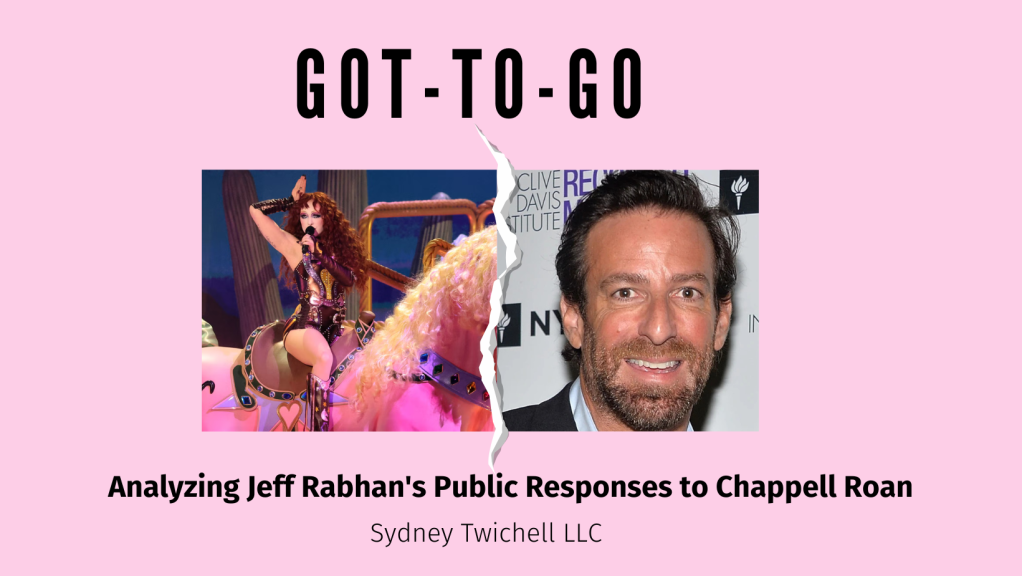
On Sunday night, February 2nd, Chappell Roan won New Artist. In her speech, which you can watch here: Chappel’s Speech, she discussed the struggles of a newly signed artist and how labels need to start providing a livable wage and healthcare. On February 5th, Jeff Rabhan wrote a response for the Hollywood Reporter which you can read here: Hollywood Reporter’s Article.
His article received a lot of backlash, but on February 6th I wrote my response: Dear Jeff. Since then, both Halsey and Chappell Roan have made responses to Rabhan.
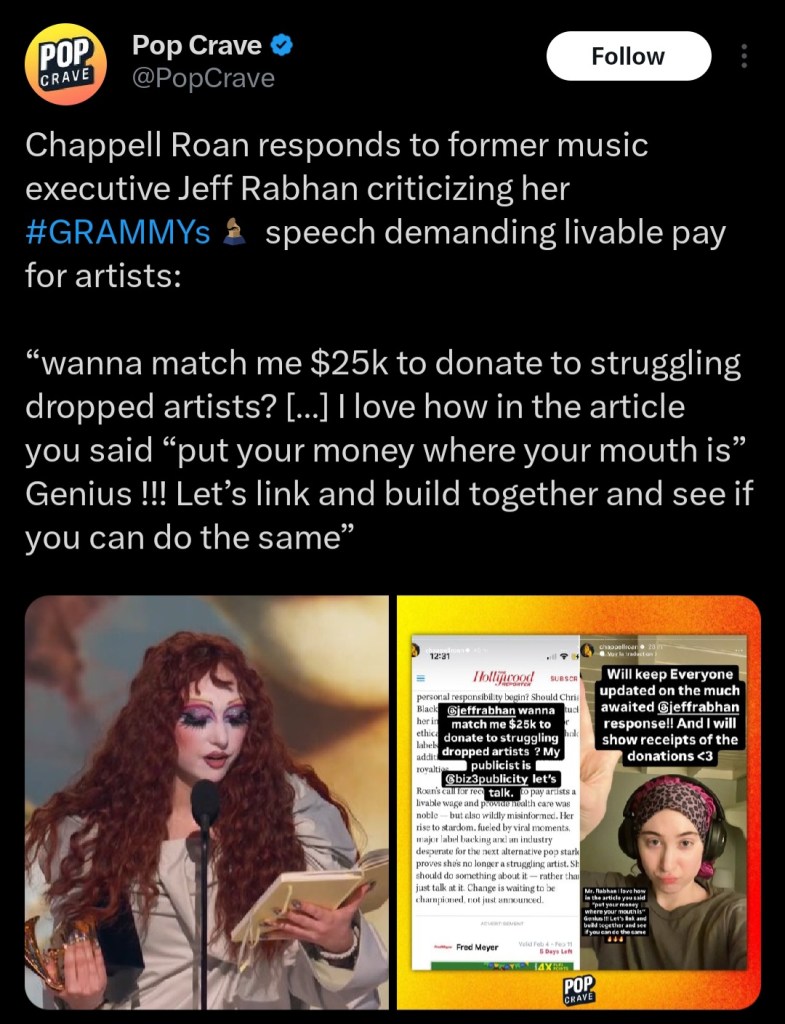
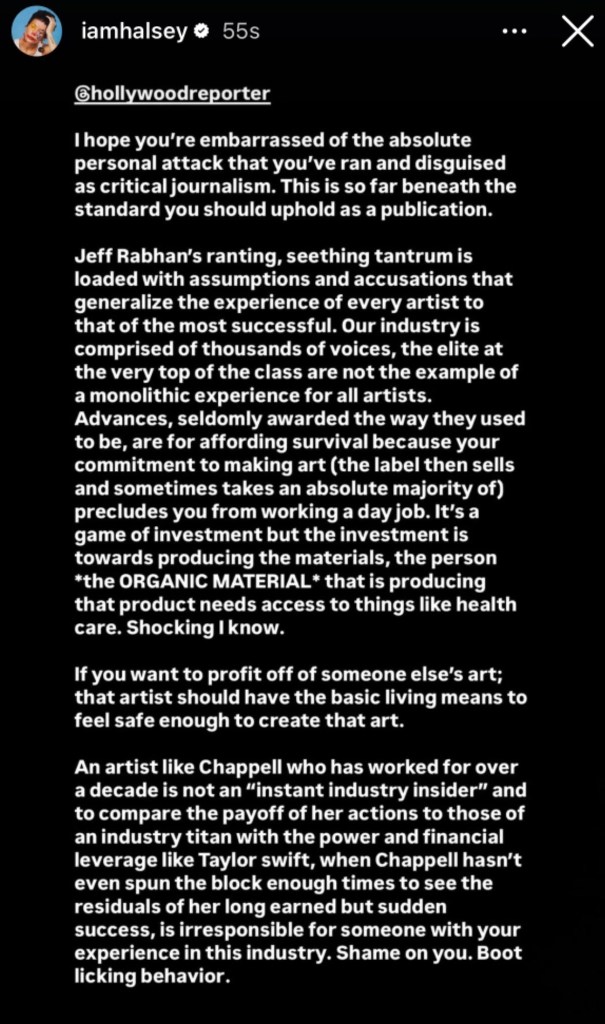
These responses caused quite a stir, prompting Rabhan to leave a series of replies and tweets in response to the two pop stars. In this article, we will be going over his responses, discussing how this response was unprofessional, and how it reflects upon the music industry at large.
I have collected some of his responses that I will post here.
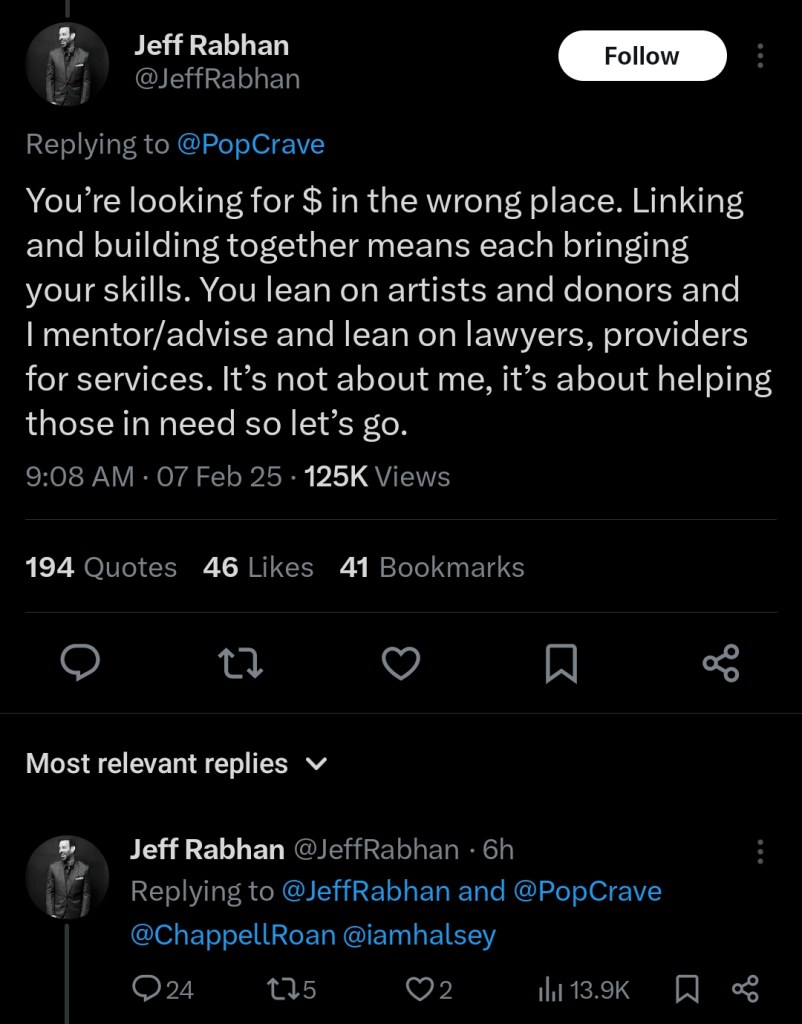
I would first like to address his response to PopCrave.
“You’re looking for $ in the wrong place. Linking and building together means each bringing your skills. You lean on artists and donors and I mentor/advise and lean on lawyers, providers for services. It’s not about me, it’s about helping those in need so let’s go.”
First, I want to point out that in response to this tweet he tagged both Chappell and Halsey. Except he didn’t tag Halsey, he tagged a random woman named Halsey. This indicates to me a hasty and not well thought out response.
Now I want to talk about this portion here where he says “it’s not about me”. Unfortunately for Jeff, this is about him. Jeff, you became the representative and mouthpiece for labels when you wrote and published the article you did in response to Chappell. You wrote as an expert, doing that puts you right in the center of this discussion.
Additionally, I would like to ask why Chappell needs to lean on fellow artists and donors? The point of her speech was that labels are not providing for their artists like they should. As he put it, labels are investing in these artists. But if artists are struggling to survive while creating art for them, then the labels are not protecting their investments.
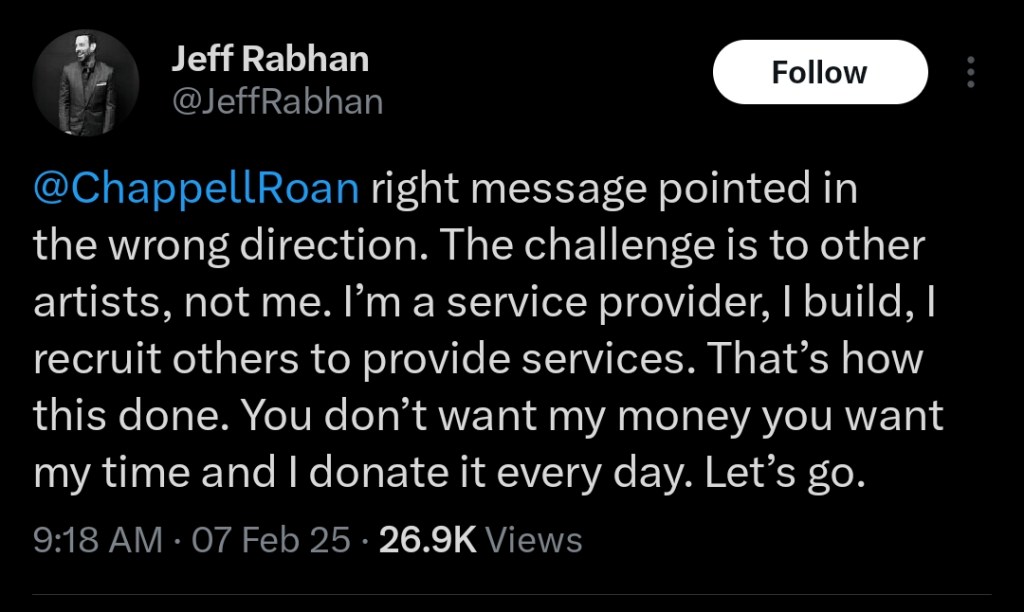
“@ChappellRoan right message pointed in the wrong direction. The challenge is to other artists, not me. I’m a service provider, I build, I recruit others to provide services. That’s how this done. You don’t want my money you want my time and I donate it every day. Let’s go.”
First of all, this isn’t a challenge. This isn’t an internet dare. It is a call to make a real difference. A call HE suggested in his article. Her asking for him to match her donation is in direct response to him suggesting she calls on industry powerhouses. If he is not one, then why did he put himself in the position of one by writing that article in the first place?
Secondly, he is not a service provider. Label executives are not service providers. They are not providing a service to the artist because the artist is not paying them to provide a service. The artist is collaborating through contracts to create a product they can sell. This means in this regard, the artist is the service provider, as the label is paying them for their service in creating art.
Jeff, you keep saying “let’s go” in your tweets, but go where? You’re not actively trying to work with these artists, you’re telling them what to do. If you wanted to “go” and do something about it, you would be contacting these artist’s teams to set something up instead of publicly taking it to social media.
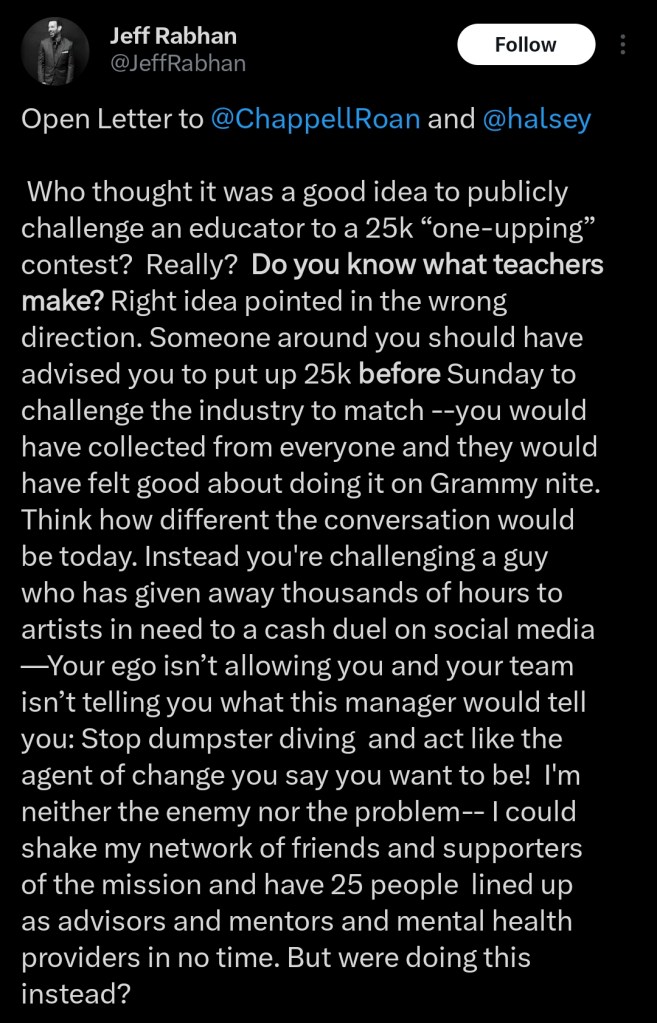
“Open Letter to @ChappellRoan and @halsey
Who thought it was a good idea to publicly challenge an educator to a 25k “one-upping” contest? Really? Do you know what teachers make? Right idea pointed in the wrong direction.”
Yes, he is currently an educator. However, he has also had many other titles under his belt both previously and currently, including CEO. Jeff, you are an educator, but you’re not the average American educator. You have influence in the industry (that’s why you wrote the article) and could have easily responded in a professional manner calling your peers to help donate to match her donation. That is, afterall, what you want Chappell to do.
“Someone around you should have advised you to put up 25k before Sunday to challenge the industry to match –you would have collected from everyone and they would have felt good about doing it on Grammy nite. Think how different the conversation would be today.”
Her speech was focused on the need for labels to do what they should be doing: protecting their investment. Donating that much before the Grammys would have taken away from the message she was trying to convey. Additionally, the Grammys was already raising donations for those suffering from the LA fires. Her trying to get donations in addition to this would have taken away from the already ongoing movement.
“Instead you’re challenging a guy who has given away thousands of hours to artists in need to a cash duel on social media—Your ego isn’t allowing you and your team isn’t telling you what this manager would tell you: Stop dumpster diving and act like the agent of change you say you want to be!”
She has not challenged you to a cash duel. She’s doing what you told her to do, and expecting you to do the same: put your money where your mouth is. She is acting like an agent of change, it just isn’t in the way you personally want her to do it.
“I’m neither the enemy nor the problem– I could shake my network of friends and supporters of the mission and have 25 people lined up as advisors and mentors and mental health providers in no time. But were doing this instead?”
Again, he has placed himself as the representative and mouth-piece for labels. If her speech was to labels, and you respond as that representative, then she will respond to you. She isn’t making him the enemy or the problem, but his unwillingness to work with her and his public responses are what is painting him as such. He still could shake his network up and do those things because he holds those cards, he is the one choosing to do this instead.
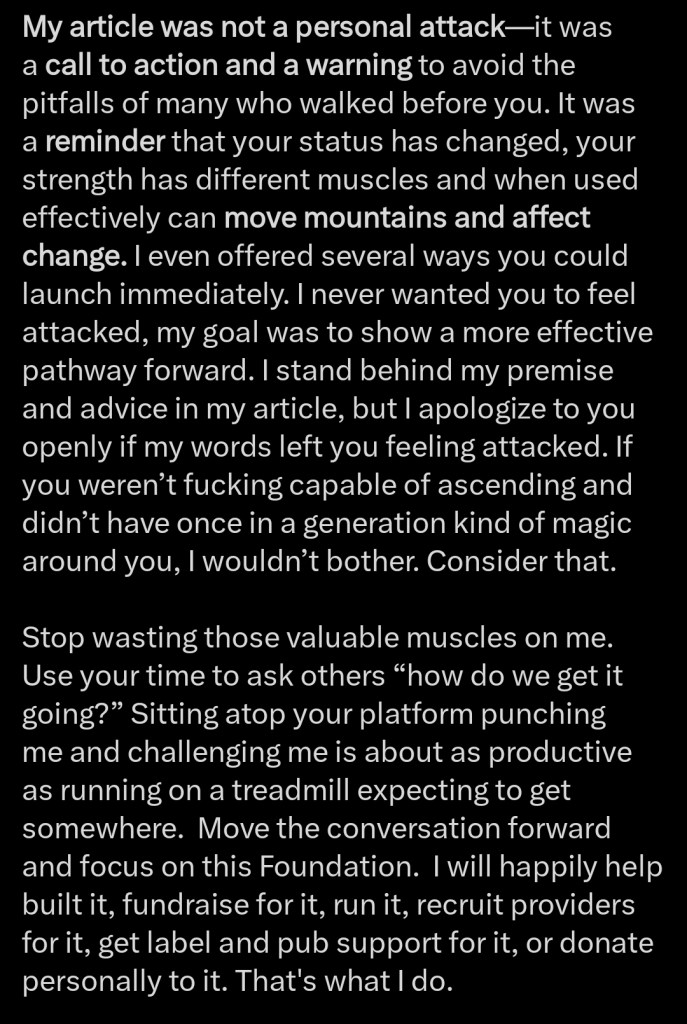
“My article was not a personal attack”
I want to focus on this part right here. You’ve highlighted it in bold to make your point known. However, in the article you repeatedly infantilized her by using child imagery, and said things that were not true about her experience and knowledge of the industry. That is a personal attack.
“—it was a call to action and a warning to avoid the pitfalls of many who walked before you. It was a reminder that your status has changed, your strength has different muscles and when used effectively can move mountains and affect change. I even offered several ways you could launch immediately.”
Her response is walking in the status and strength she has. She is acting on the ways he suggested, but she is starting with the person who brought the ideas to her attention. This is a very smart move on her part. In business, when someone proposes an idea, you typically work with that person to make those ideas happen. If he didn’t want to be involved, it may have been smart for him to not make those suggestions.
“I never wanted you to feel attacked, my goal was to show a more effective pathway forward. I stand behind my premise and advice in my article, but I apologize to you openly if my words left you feeling attacked. If you weren’t fucking capable of ascending and didn’t have once in a generation kind of magic around you, I wouldn’t bother. Consider that.”
If he didn’t want her to feel attacked, the wise thing would have been reaching out to her personally to offer advice. Not writing a public article that repeatedly put her down, and used imagery to make her look smaller.
Additionally, saying an apology followed by an f-bomb is highly unprofessional, and shows a lack of genuine remorse for making her feel attacked. It only reinforces those feelings of being attacked.
“Stop wasting those valuable muscles on me. Use your time to ask others ‘how do we get it going?’ Sitting atop your platform punching me and challenging me is about as productive as running on a treadmill expecting to get somewhere.”
She isn’t punching or attacking you Jeff. Again, she is doing what you suggested and going to you first because you were the one that made the suggestion. Are you saying you don’t have the influence and power to help make things happen? If so, then you shouldn’t have written the article in the first place.
“Move the conversation forward and focus on this Foundation. I will happily help built it, fundraise for it, run it, recruit providers for it, get label and pub support for it, or donate personally to it. That’s what I do.”
He has repeatedly shown in his responses that the focus shouldn’t be on him, and that he is the wrong person to go to. Yet here, he is putting himself at the center again as someone she should go to. You can’t tell her to stop focusing on you, but then make yourself someone she should talk to. You can’t drop f bombs and belittle her in articles, and then make yourself a trustworthy person for her to rely on in her mission. If you truly wanted to move the conversation forward, this wouldn’t be a public tweet. You would be reaching out to her privately to help start something.
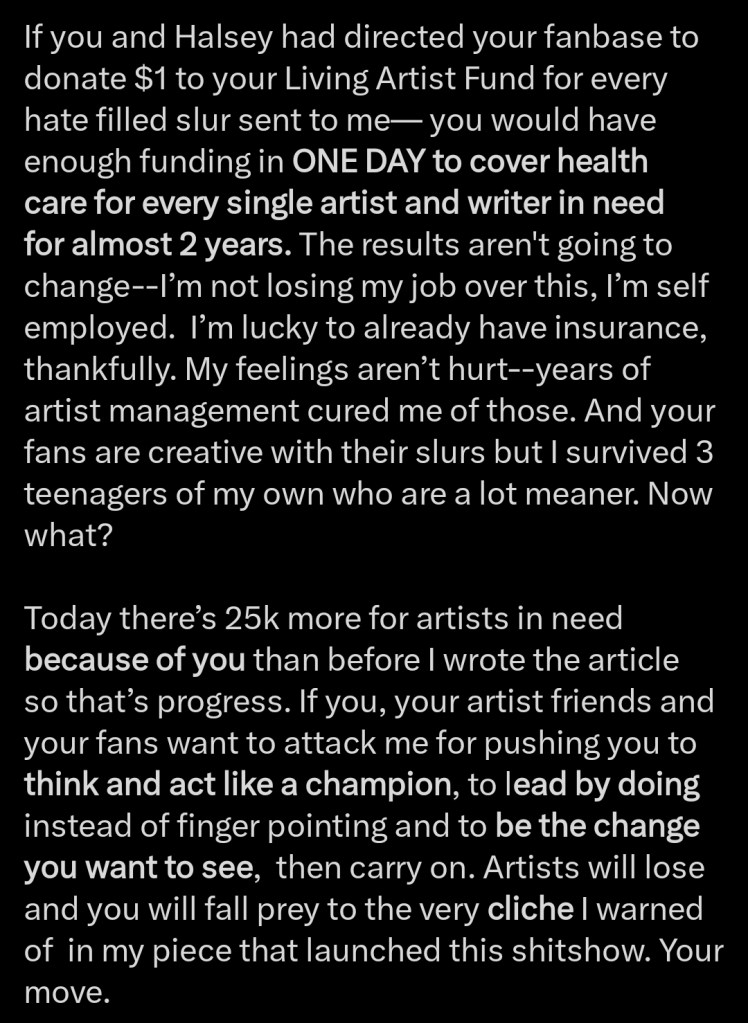
“If you and Halsey had directed your fanbase to donate $1 to your Living Artist Fund for every hate filled slur sent to me— you would have enough funding in ONE DAY to cover health care for every single artist and writer in need for almost 2 years.”
He is speaking as if they personally sent their fanbase after him. They didn’t. As a former manager Jeff, you should know how quickly a fanbase will turn on someone without an artist saying anything.
Additionally, why are we now putting it on the fans to feed and provide healthcare to artists? Her entire point was that labels should be doing that. Trying to get donations from artists, and now fans, is only putting a bandaid on what is now a gaping wound. Especially when his last article mentioned others in the industry like writers and managers also being in need of these basic necessities.
“The results aren’t going to change–I’m not losing my job over this, I’m self employed. I’m lucky to already have insurance, thankfully.”
Jeff, this was unnecessary to add and takes away from what you are trying to say. This comes off as boasting in the face of someone bringing up very real concerns. Talking about having a liveable wage and healthcare when the discussion is about those who don’t have it is distasteful and tactless.
Additionally, this discredits the beginning of your tweet where you state you’re an educator. By bringing up this portion, it shows us, the audience, that your intention was to paint yourself as an average, underpaid teacher in America in an attempt to sway public opinion about Chappell’s response.
“My feelings aren’t hurt–years of artist management cured me of those. And your fans are creative with their slurs but I survived 3 teenagers of my own who are a lot meaner. Now what?”
Again, nobody sent their fans after him. Bringing up their fans as if they have control yet again takes away from what he is trying to say here. His long winded tweet, which has been edited multiple times since I first drafted this article, is an indicator that some feelings are hurt in this week’s dumpster fire. If they weren’t, this open letter at the very least wouldn’t be full of tactless and useless statements. At the most, this open letter never would have happened, and a private discussion would have been held. She linked her publicist, there was no reason to not handle this privately. Instead, we are witnessing a public spectacle.
“Today there’s 25k more for artists in need because of you than before I wrote the article so that’s progress. If you, your artist friends and your fans want to attack me for pushing you to think and act like a champion, to lead by doing instead of finger pointing and to be the change you want to see, then carry on. Artists will lose and you will fall prey to the very cliche I warned of in my piece that launched this shitshow. Your move.”
She didn’t attack him. She didn’t send her fans to attack him. She didn’t send other artists to attack him. She isn’t pointing fingers either. She is doing what he told her to do, it’s just in a way he personally doesn’t like. However Jeff, you are pointing fingers instead of leading. You are pointing at other artists to fix the problem and attempting to dictate how. If you truly cared about the issues in the industry, you would be working with these artists and leading the charge you set.
These responses from Rabhan show a lack of careful consideration, emotional regulation, and PR directed class. By publicly responding instead of privately working on a solution, Rabhan has once again set himself at the center of the discussion. He calls for action, but doesn’t like when he is expected to follow his own words.
Jeff, if you are calling for change then you need to be willing to put in the work. In the same way you expect Chappell to do something about it, Chappell expects you to also follow through. You aren’t showing good leadership, mentorship, or expert qualities. You placed yourself in a position of authority when you wrote an article calling for Chappell to do better. You cannot be upset, dismayed, or thrown off when she treats you with the level of influence you placed upon yourself.
Chappell wasn’t targeting anybody specific in her speech. She was simply stating that if labels want artists to produce work for them, then they need to care for their artists properly. This response from Rabhan reflects a general understanding in the music industry: they don’t care. The industry is upset that their workers expect basic needs to be met.
This series of events this week may be the start of major shifts in the music industry. Artists are tired of being used by the industry. They don’t want to put in all the work without the support of the label, and they are fully within their rights to feel that way. If an artist gets sick with no healthcare, the label isn’t going to get the product they need in a timely manner in order to see a return on their investment. If an artist has to take on extra jobs to pay the bills, the label isn’t going to get the quality they want from an exhausted artist.
With artists publicly making a stand this week, and with ongoing rumors of Taylor Swift possibly starting her own label, we can only hope that this week has started a positive change in an industry that consumers love.
 Sydney Twichell LLC
Leave a comment