
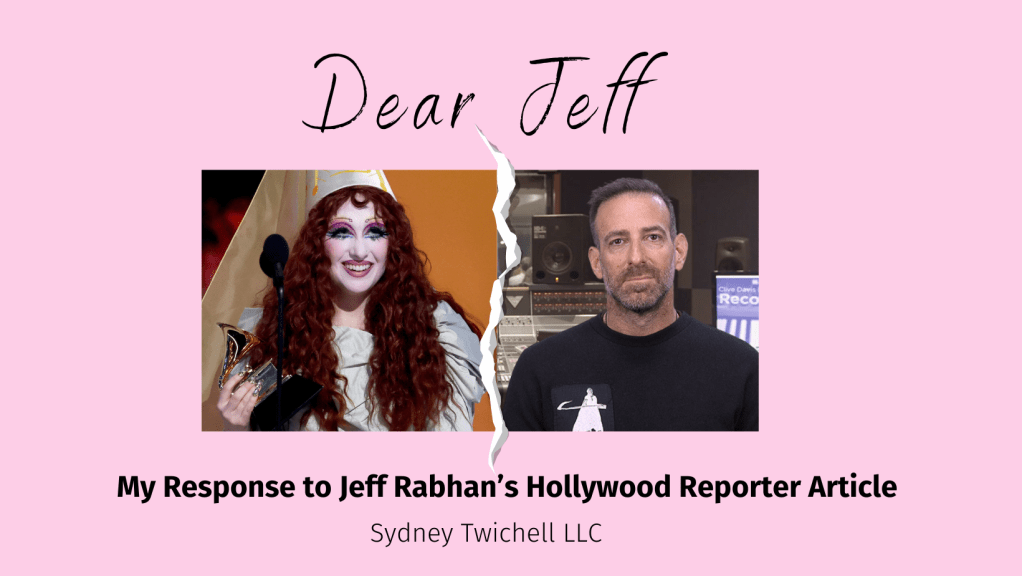
Yesterday the Hollywood reporter dropped an article in response to Chappell Roan’s speech at the Grammy’s. I highly encourage you to watch her speech, and read their article before continuing as I feel the context is important to what I am discussing.
The writer of that article is written by Jeff Rabhan, an american music industry executive, artist manager, Arts Professor and former Chair of the Clive Davis Institute of Recorded Music at Tisch School of the Arts, New York University (NYU).
Jeff, I have some thoughts on what you wrote.
Rabhan starts his article strong.
“What would Prince say? Or Tom Petty? They fought for their souls and for the rights to their music, putting their careers in jeopardy for what they believed was artistic integrity — the hallmark of greatness.”
Starting your article with discussing male artists from the 80s is interesting. Though their fight may be relevant, they aren’t exactly comparable to the young female artist of the 2020s when it comes to this discussion.
He goes on to say:
“It seems Roan wants to turn labels into landlords, bosses and insurance providers? Have you ever tried to get your expenses reimbursed from a major label? Yet somehow you want them in charge of healthcare claims?”
Labels ARE the boss. They have a contract with the artist for the artist to provide product for labels to sell. The labels are the investors, therefore in business they are a boss. She is not asking for landlords, she is stating the obvious that someone working for you, especially the hours they have to put in, should have a liveable wage and healthcare. And why won’t a major label reimburse the artist? Is that not acknowledging that the industry you are an executive in is predatory and money-hungry?
He then says:
“but her Grammy speech was a hackneyed and plagiarized script of an artist basking in industry love while broadcasting naïveté and taking aim at the very machine that got her there”
Was it actually hackneyed and plagiarized? And if it was, why do artists keep having to address it instead of labels addressing it? If you have multiple people saying there’s a problem, then there is probably a problem.
“ If labels are responsible for artists’ wages, health care and overall well-being, where does it end and personal responsibility begin?”
Labels are INVESTING in artists. If you are investing in something, you also need to protect it. If artists are starving, unable to pay their bills, or sick with no treatment then you are not protecting your investment. Yes, the label who wants to profit off of an artist’s art, is responsible for the artist’s wages, health care, and overall well-being.
“Should Chris Blackwell put a mint on her pillow and tuck her in at night, too?”
This, frankly, is a cheap shot from a professional. It is infantilization to make Chappell look too small to have an opinion on the industry she works in.
“There is no moral or ethical obligation by any standard that hold labels responsible for the allocation of additional funds beyond advances and royalties.”
If you are profiting off of an artist’s work, and the royalties are not enough to allow them to make the art for you to sell, then there IS a moral and ethical obligation to make sure they have what they need to produce the art YOU WANT.
“She should do something about it — rather than just talk at it.”
She clearly did more than just talk about it. It made you upset enough that you decided to write this article, bringing more attention to it.
“But the moment she stepped onto the Grammy stage on Sunday night, she was no longer the scrappy indie artist fighting from the fringes — she became part of the establishment. It is disingenuous to cash a fat label check, ride meaningful industry support to mainstream success and then act like the kid who didn’t get picked for dodgeball when your name is called.”
Not only is this an arrogant and wildly infantilizing statement to make, it is not disingenuous to cash the check SHE EARNED by creating her art.
“There’s still room for puppy dogs and ice cream in this story.”
Again with the infantilizing. This isn’t a professional statement to make and lacks decorum.
“they ran the numbers, assessed potential revenue and invested hard cash and company bandwidth to build her identity and a sustainable business around her music. That’s how the industry works. Record labels are businesses, not charities, and the deal is simple: They put up the money, take the risk, and in return, they get a cut of the profits.”
Yes, it is an investment. Which you should protect if you are investing that much money into them. This includes making sure they are able to eat, have a roof over their head, and healthcare to keep them healthy and able to do the work for you.
“Demanding that labels pay artists like salaried employees ignores the fundamental economic structure of the business. No one is forcing artists to sign deals. For the one-millionth time — if they don’t like the terms, they can stay independent, own their masters and take the financial risk themselves.”
They should be salaried employees, or at the very least treated as such. There are numerous ways to get contractors the healthcare they need, not to mention the pay they need in order to simply live while they do the work you have contracted them to do. You want them to put an immense amount of time, effort, talent, and themselves into their art in order for you to profit off of it. Saying “they don’t have to take the deal” when taking that deal is the best way to be a success is a disingenuous stance. That is like telling someone in poverty that if they don’t like where they live they should just move. It comes from a place of privilege and arrogance.
“So a label should be slapped for running their business like a business, while your advance goes toward more important things — like a personal ayahuasca shaman from Detroit and a toilet that speaks four languages? Make it make sense.”
You’re not operating like a GOOD business if you cannot provide for the most important people within your business. Without artists, there is no art to sell. And bringing up extreme straw man arguments to downplay what she said is even more disingenuous. She’s not asking for luxury, she is asking for necessities. If it doesn’t make sense, then you may not be as good at your job as you think.
“Why isn’t Roan pushing her artist peers to put their money where their mouth is and donate 2-3 percent of their advance to a fund that supports fellow artists? She’s now breathing rarefied, elite-level air, and the time is limited to get the Beyoncés, the Biebers, the Taylors, the Brunos on board — since the only way across the finish line is top-down funding.”
This is the same mindset as a restaurant not paying a liveable wage and expecting customers to pay the difference through tips. The music industry makes roughly 28 BILLION a year, but you want artists to feed other artists instead of the labels that are selling and profiting off of their art.
“If they’re truly concerned about a livable wage, maybe they should look at how their advances are structured first.”
A lot of the artists that labels sign are young and naive. Chappell herself said in her speech that she was a minor when she first signed. Are you saying the labels are predatory to young artists?
“but writers, the backbone of this industry are suffering far worse than performing artists, so this whiny expectation that labels and/or publishers should be responsible for making sure artists function as fully formed adults is absurd and reeks of entitlement.”
Why are you letting writers suffer? Why are they struggling? That shows a bigger problem with the industry, not the artists. In addition, workers wanting a liveable wage and healthcare from their employers is being a fully formed adult.
“Major labels take at least a seven-figure risk on every artist, knowing that almost 60 percent never recoup a fraction of the costs and 15 percent cover the bills for the entire roster.”
Is it possible that the percentage of “failed” artists would go down if you paid them enough to live and covered their healthcare? They wouldn’t need second and third jobs to live or get access to healthcare, they could give their all to their music. Isn’t that what you want out of your investment?
“Sounds like a union thing to me.”
If you actually practiced good business they wouldn’t need to unionize in order to get basic needs covered. You are an executive Jeff, you understand how that hurts YOU if you artists need to unionize to get their basic needs met… right? If they do unionize, I hope you support them. Judging by this article however, I don’t think a union is actually what you would want in this situation.
“Most independent managers don’t have insurance either — it’s a flaw in the industry at large, not just on the label side.”
This shows that there is a major problem in the industry. However, as an industry executive should you not be advocating to help fix that?
“Artists can negotiate their deals any way they choose — to direct a portion of their advance towards healthcare coverage, just like they do with recording costs. Some already do.”
This implies that they should take away from the resources required in order to make the quality music you want in order to get healthcare. That isn’t fixing the problem.
“Isn’t an advance for that precise purpose? One might argue that the six-figure advances labels pay just for signing your name are livable — and they certainly buy you time to make the entire record you promised before you run out of cash, right?”
Well hold on there. You stated this two paragraphs previously:
“When an artist signs a contract, the label provides an advance, which is essentially a loan. That advance covers recording costs, marketing, distribution, and — if negotiated — tour support.”
You listed above all of the things an advance is supposed to cover. A 6-figure check will be eaten up quickly trying to produce the quality you want from them. How much exactly is the 6 figures? 100,000? That isn’t much to cover the costs you just mentioned AND daily needs AND healthcare. Most of these artists live in LA, a very expensive city to live in. A 6 figure check is not a lot when you expect it to cover EVERYTHING you just stated.
“‘Let’s be revolutionaries — right after my direct deposit hits’ is a sham.”
It is not a sham to cash the check you worked for. It is not a sham to demand better working conditions while cashing the check you already earned by doing the work you already did.
“Roan is uninformed — not because she’s untalented, but because she hasn’t lived in the industry long enough to understand its intricate workings.”
She has been in the industry for 11 years. If that isn’t enough time to understand any industry you’re working in, then what are you trying to say? If it took you that long to understand the industry, that may be more of a reflection on you than Chappel.
“Now anointed best new artist, she’s experiencing her first wave of mainstream success and, like many before her, believes she’s in a position to dictate systemic change without offering tangible solutions.”
She isn’t dictating anything. She made a statement about a corrupt part of the industry she has been in for over a decade and finally has the reach to talk about it in a meaningful way.
“young stars getting a taste of success, turning into critics of the machine that elevated them, and ultimately, continuing to profit from that very system.”
Again, she should make a profit from the work she has already put in. Her making money from the work she has done doesn’t make her points irrelevant or invalid. In fact, her success highlights the validity of her concerns because it shows she’s been working hard in the industry. The numerous artists standing and applauding her further validates her statement.
“ there are real ways to make a difference:
- Start a foundation that helps independent artists with healthcare and fair compensation — and demand your fellow Grammy winners match your funding.”
Why is your industry so corrupt that you need to start a foundation to help it? This doesn’t fix anything, it simply puts a bandage over the wound. Additionally, you’re suggesting that she should DEMAND other artists to donate? You are upset that she demanded basic needs from labels but think it wouldn’t be out of line to do the same to the artists she’s advocating for?
“Offer mentorship programs for young musicians navigating label contracts.”
So you admit that label contracts are so predatory that young artists need help navigating around the predatory practices. I agree that a mentorship program would be beneficial, but you suggesting it as an executive shows you know how bad these contracts can be. This only further reinforces her statement.
“Put your money where your mouth is and invest in new models of artist compensation instead of expecting labels to change overnight.”
Nobody is demanding change overnight. They’re just demanding change in general. If you are saying she’s copying other artists with her speech, then why haven’t labels started to change? You state that writers and independent managers suffer the same issues, why are the labels this behind in addressing these issues?
“Taylor Swift didn’t just complain — she re-recorded her entire catalog and managed to gross a billion dollars in her spare time.”
Yes, Taylor did something about the horrible situation labels put her in. But at that time, Swift had already been a huge success in the industry for a while, with the money and name to back her. She was worth around 570 million when her masters were sold. Chappell is just now becoming a household name, with a very rough net worth of around 10 million (probably less than that considering most Google searches are not accurate when it comes to the net worth of a person.) That is a very big gap, making the two incomparable in this discussion.
“This isn’t a game of laser tag at the mall with your friends – it’s bare knuckle warfare at sold-out Madison Square Garden — it’s the toughest business on earth.”
Here we see more infantilization. Also, why are you waging war against your artists? The artists you need in order for the industry to even exist? Framing it like a bare knuckle war makes the executives like yourself look worse if anything.
“She alone cannot change what requires a village. Get off the Grammy stage and find the smartest people you know to help build a platform.”
She doesn’t expect to stand alone. Why do you think she said what she said to a room full of other artists in the industry? She is speaking to the people you want her too, in a quick and accessible way. Additionally, why are we assuming she hasn’t talked to others off stage?
The reality is Jeff, the music industry is full of corruption. The public learns of new layers every single day. You say that if artists want change they should make efforts to change it. Yet you, an executive in the industry, have made your position clear. You don’t want change, you want artists to continue to struggle while lining your pockets with the art they created.
You call for unions, but what will actually happen when a union steps in? Your industry will take a hit while they wage war against their own artists. You claim Roan is speaking empty words and not making a difference, and yet she got you rattled. You wrote an entire article based on 30 seconds of her Grammy speech. In fact, you wrote an article that basically admits the industry that YOU are an executive in is predatory and corrupt towards young people. You admit there is corruption but have done nothing to fix it. Instead, you want artists to do your job. Consistently infantilizing Chappell using child imagery is an effort to try and delegitimize her stance and anything else she says in the future.
I started my business last year with the tagline “Revolutionizing The Way We Do Business”. And though my business is not involved in this industry, this article paints a broader picture in how business is conducted today. Rabhan references how this is a business several times as an excuse to neglect the very people that make this industry what it is. Businesses in all industries have this issue of not caring for their workers. Without your employees, your business would crumble. So why, as a leader, would you not want to care for the people that hold you up? If employees are the foundation of the pyramid you stand on top of, then why don’t you want that foundation healthy, safe, and cared for? A good leader wants their followers, employees, and contractors to be healthy and thriving. They want their work to reflect the excellence of the company, so why would you neglect the things they need to reach their full potential? If you are an investor, why aren’t you protecting your investments?
“I am certain that the very real struggles our beautiful, creative community face are deserving of far more than a “trending” sticker for just one day.”
Thanks to your hit piece, this will be trending much longer than just one day. And it’s gonna trend in a way you don’t like. Welcome to the internet.
 Sydney Twichell LLC
Leave a comment